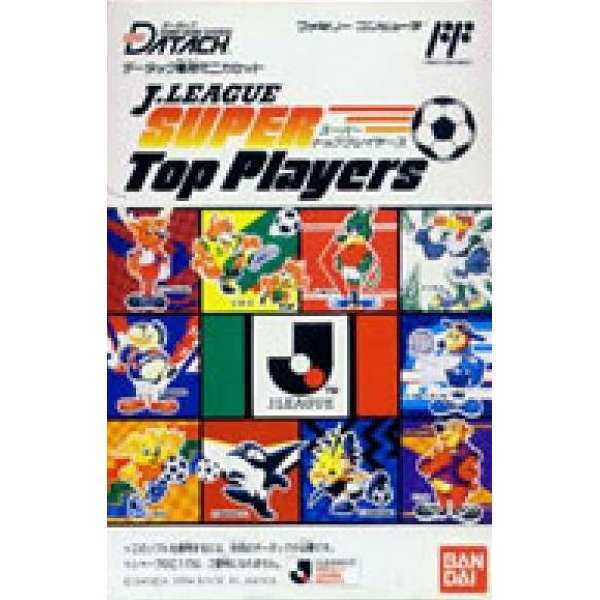
讀卡機系列:J聯盟足球
 1994-04-22
《J 聯盟足球:超級頂尖球員》(Datach - J.League Super Top Players / データック Jリーグスーパートッププレーヤー)是由Bandai於1994年4月22日在任天堂 Famicom(紅白機)上發行的作品,同時也是Datach Joint ROM System讀卡機系列的最終作。誕生於日本職業足球聯賽(J.League)剛成立不久、全國掀起足球熱潮的時代背景下,將現實中的球星卡片與電子遊戲進行結合,試圖在8位元主機上呈現一場由玩家親手「掃描打造」的足球競技體驗。
在基本表現上,可說是對紅白機硬體極限的一次挑戰。需要透過Datach讀卡機掃描實體球員卡,將真實存在的球星數據導入遊戲中,組建專屬球隊。當時卡片中收錄如三浦知良與拉莫斯瑠偉等人氣球星。畫面風格採用當時常見的Q版大頭比例設計,球場色彩鮮明,雖然受限於8位元性能,角色動作較為簡潔,但透過數值差異,球員在速度、射門與體力上的表現仍有明顯區別。背景音樂節奏輕快,並融入觀眾歡呼與哨聲效果,搭配刷卡時的電子音,成功營造出結合現實與數位的比賽氛圍。
在劇情設定上,並沒有過多虛構故事,而是直接以J聯盟賽制為核心。玩家扮演一名新成立球隊的教練兼經營者,目標是在競爭激烈的聯賽中逐步崛起,最終奪得冠軍榮耀。遊戲的重點不在於戲劇化的情節,而在於「現實連動感」的呈現——玩家手中的實體卡片就是球隊的根基,透過不斷收集與掃描球員卡,打造夢幻陣容,體驗從球迷到冠軍教頭的成長歷程。
在操作與系統方面,將場外與場內玩法緊密結合,形成獨特的遊戲節奏。在比賽前需掃描球員卡條碼,系統會依據條碼生成各項能力數值,如技術、速度、體力與射門能力。除了官方卡片之外,當時玩家也常嘗試掃描日常商品條碼,希望「意外生成」能力爆表的隱藏球員,這種場外探索成為遊戲的一大樂趣來源。
進入比賽後,操作方式結合簡化的動作元素與策略判斷。可以進行基本的傳球、射門與防守操作,而在關鍵時刻則會轉為指令選擇,依據球員狀態與能力決定戰術。由於硬體限制,整體操作偏向策略模擬而非純動作遊戲,但這也讓玩家更重視賽前配置與臨場判斷。此外,陣型配置與體力管理亦是勝負關鍵,玩家可依球員特性安排不同戰術陣型,並在比賽中透過即時掃描候補球員卡進行換人,這種「刷卡換人」的設計在當時極具創新感。
在市場評價方面,被視為一款極具時代象徵性的作品。評論普遍認為它成功捕捉90年代初日本足球熱潮與卡片收集文化的結合,展現出高度的創意與實驗精神。然而,由於發售時期紅白機已逐漸退場,加上Datach讀卡機本身普及率有限,使得本作的流通量相當稀少。整體而言,它更像是一件融合遊戲與收藏價值的科技產品,而非單純追求遊戲性的作品。儘管如此,仍被認為是8位元時代末期的重要實驗之一,證明即使在主機生命週期的尾聲,透過創新的硬體與玩法設計,仍能為老平台帶來嶄新的互動可能。
J.League Super Top Players (Datach - J.League Super Top Players / データック Jリーグスーパートッププレーヤー) was released by Bandai on April 22, 1994, for the Nintendo Famicom (NES). It was also the final title in the Datach Joint ROM System lineup. Developed during the early boom of the J.League, when professional soccer had just taken off in Japan, the game combined real-world player cards with digital gameplay, attempting to create a soccer experience on 8-bit hardware that players could literally “scan” into existence.
From a technical standpoint, the game pushed the limits of the aging Famicom hardware. Players were required to use the Datach barcode reader to scan physical player cards, importing real-world athlete data into the game to build their teams. The included cards featured well-known players such as Kazuyoshi Miura and Ruy Ramos. Visually, the game adopted a super-deformed (SD), big-headed character style typical of soccer games at the time. The pitch was rendered in bright green tones, and although player animations were relatively simple due to hardware limitations, differences in stats such as speed, shooting power, and stamina were clearly reflected during matches. The background music was upbeat and incorporated crowd cheers and whistle sounds, while the barcode scanning effects added a distinct digital “ritual” feeling to the experience.
In terms of narrative, the game did not rely heavily on fictional storytelling. Instead, it followed the real-world structure of the J.League. Players took on the role of a newly formed club’s manager and coach, aiming to rise through the competitive league and ultimately win the championship. The core appeal lay in its sense of real-world integration—your physical cards were your team. By collecting and scanning player cards, you gradually built a dream squad and experienced the journey from an ordinary fan to a championship-winning manager.
Gameplay mechanics revolved around a unique fusion of off-screen preparation and on-field decision-making. Before matches, players scanned barcode cards to generate character stats such as technique, speed, stamina, and shooting ability. Beyond official cards, players at the time often experimented with scanning everyday product barcodes, hoping to “discover” overpowered hidden players—an off-game activity that became one of the title’s most memorable features.
During matches, the gameplay combined simplified real-time controls with strategic elements. Players could perform basic actions such as passing, shooting, and tackling, while key moments would shift into command-based decision sequences. Due to hardware constraints, the overall feel leaned more toward a strategy simulation than a fast-paced action game, placing greater emphasis on pre-match planning and tactical judgment. Formation setup and stamina management were also crucial; players could arrange lineups based on scanned attributes and even substitute players mid-match by scanning new cards in real time—a highly innovative feature for its era.
Critically, J.League Super Top Players was regarded as a product deeply tied to its time. Reviewers praised its creative fusion of Japan’s early 1990s soccer boom and card-collecting culture, highlighting its experimental ambition. However, because it was released late in the Famicom’s lifecycle and required the relatively uncommon Datach hardware, its market reach was limited. As a result, it came to be valued more as a collectible and technological curiosity than a purely gameplay-driven title. Even so, it is widely recognized as one of the final experimental highlights of the 8-bit era, demonstrating that even aging hardware could still deliver fresh interactive experiences through innovative design.
運費計算方式:
貨款滿1000元運費外加90元
貨款1000以下:買1件運費外加 60元,買2件運費外加 70元,
買3件運費外加 80元 ,買4件運費外加 90元
貨到付款外加30元手續費
外島及大陸地區運費另計
付款方式:
線上刷卡:本站採用Paypal線上刷卡
虛擬帳號匯款:屬於您專屬的虛擬帳戶,方便站長查帳使用,本站強力推薦
實體ATM匯款:請將匯款帳號記錄下來至各大銀行ATM提款機轉帳
超商條碼繳費:請列印本站提供的條碼至四大超商繳費
線上轉帳:透過玉山銀行線上ATM轉帳(此系統只支援IE瀏覽器)
貨到付款:本站採用黑貓宅急便貨到付款
其他注意事項:
如需購買線上點數卡請直接跟站長連絡,本站不提供點數卡的線上付款
-
讀卡機系列:J聯盟足球
- 定 價: 2,800円
- 售 價: 0.00
- 庫存量: 0 套
- 已賣出: 0 套
人氣指數: 0 / 6 顆星