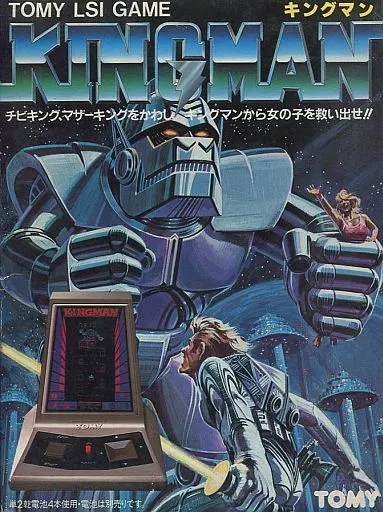
LSI掌上型遊戲 KINGMAN
這款 TOMY LSI 掌上型電子遊戲《KINGMAN》(キングマン),是日本玩具與電子遊戲發展早期極具時代象徵性的作品之一。誕生於 1981年,正值任天堂《咚奇剛》(Donkey Kong)席捲全球、徹底改變遊戲產業方向的關鍵年代。在那個街機文化剛開始影響家用與掌上遊戲的時期,本機可以說是對《咚奇剛》熱潮最直接、也最具代表性的回應之一,同時也展現TOMY 在 LSI 電子遊戲領域一貫的工藝野心與創意嘗試。
從劇情設定來看,主要的核心結構幾乎可以視為《咚奇剛》的變奏版本。故事描述一名男孩為了拯救被擄走的女孩,必須一路向上攀爬,突破重重阻礙,最終挑戰盤踞在最上層的「KINGMAN」。過程中,會不斷遭遇名為「チビキング」的小型敵人,它們會滾動或從上方掉落,成為通往頂層的最大威脅。此外,還有負責「生成敵人」的マザーキング,以及阻擋通道的危險存在。對熟悉《咚奇剛》的玩家而言,幾乎可以輕易對應出角色關係:KINGMAN 對應 Donkey Kong,チビキング 類似滾動木桶,而所謂的「ワープトンネル」則扮演梯子的功能。這樣的設計並非單純抄襲,而是在當時技術與市場環境下,一種合理且可預期的致敬與借鑑。
然而,真正讓《KINGMAN》試圖與同類作品拉開距離的,是它在電子遊戲框架內,努力實現「四種不同關卡型態」的野心。整體遊戲目標相當明確,只要操控男孩成功抵達最上層,便可完成關卡。但每一個關卡的地形與陷阱配置卻各有不同。第一與第三關偏向經典的橫向移動與跳躍,但第三關加入「地板消失」的變化;第二關則讓敵人改以垂直掉落的方式施壓;而第四關更進一步引入會移動的平台、需要撿取武器並與 KINGMAN 正面對決,甚至還加入結局後的「救出女孩演出」與額外得分判定。以 1980 年代初期的 LSI 電子遊戲來說,這樣的變化幅度其實相當罕見,也顯示 TOMY 並未滿足於只做單調的仿作。
在操作層面,整體的評價則明顯分歧,也是這款遊戲最受批評的地方。玩家主要透過控制按鈕與跳躍按鈕來移動角色,但角色的移動反應相當遲鈍,無法像《咚奇剛》那樣靈活地在敵人之間穿梭。這種「不夠即時」的操作手感,讓遊戲在要求精準跳躍與快速判斷的情況下,反而產生強烈的挫折感。尤其在第四關,面對從上方突然掉落的チビキング時,往往因角色移動速度不足而難以應對,這並非技巧不足,而是系統本身的限制所導致。
遊戲的跳躍系統仍可看出對《咚奇剛》的致敬痕跡。可以選擇原地垂直跳躍或斜向跳躍,並依跳躍方式獲得不同分數。這種設計在當時的電子遊戲中算是相當進階,也試圖賦予玩家更多操作層次。此外,遊戲中還加入「パワーハート」作為短時間無敵道具,在有限時間內反擊敵人並累積高分,進一步強化冒險與風險回報的節奏。
在視覺與角色表現上,則顯得略為保守,甚至可以說是它最難留下深刻印象的部分。KINGMAN 本身的造型還算有特色,但其他角色無論是チビキング還是主角男孩,都缺乏鮮明個性。特別是主角的跳躍動畫,僅僅是把站立姿勢的下半身消去,讓人幾乎感受不到「跳躍」的動感。這在角色魅力成為街機遊戲成功關鍵的年代,無疑是相當吃虧的。整體畫面雖然透過鏡片放大,提供當時少見的大型顯示效果,但角色表現力仍受限於硬體設計。
音效與音樂同樣是玩家評價偏低的一環。遊戲旋律多半偏向低沉,缺乏明快與振奮的情緒,與「英雄救美」的主題並不完全契合。甚至有玩家表示,在遊玩《KINGMAN》之後再接觸其他電子遊戲,會明顯感覺那些作品的音樂「異常明亮」,這也從側面反映出本作音效氛圍上的獨特卻略顯壓抑的風格。
至於市場評價,在當年確實具有相當的存在感。大型機身、寬廣螢幕與多關卡設計,使它在眾多掌上電子遊戲中顯得格外醒目。然而,操作性與角色魅力不足,也讓它難以成為真正的長青名作。時至今日,本作更多是以「歷史性產品」與「TOMY LSI 系列的重要一環」被收藏家與懷舊玩家所關注,而非因遊戲性本身受到推崇。在二手市場上,它的價值也往往建立在品牌情懷與稀有性,而非純粹的遊玩體驗。
總體而言,《KINGMAN》是充滿時代氣息的作品。它並非完美,甚至在操作與表現上留下不少遺憾,但在 1981 年那個電子遊戲尚未定型的年代,能夠在有限硬體條件下嘗試四種不同關卡結構,本身就值得肯定。對 TOMY 粉絲與早期遊戲文化愛好者來說,《KINGMAN》不只是模仿《咚奇剛》的嘗試,而是一段見證電子遊戲從玩具走向產業的歷史片段,至今仍具有不可取代的懷舊價值。
TOMY’s LSI handheld electronic game KINGMAN (キングマン) is one of the most emblematic products from the early formative years of Japan’s toy and video game industry. Released in 1981, it emerged at a pivotal moment when Nintendo’s Donkey Kong was sweeping the world and fundamentally reshaping the direction of the gaming industry. At a time when arcade culture was just beginning to influence home consoles and handheld devices, KINGMAN can be seen as one of the most direct and representative responses to the Donkey Kong phenomenon, while also showcasing TOMY’s long-standing ambition and craftsmanship in the field of LSI electronic games.
From a narrative perspective, the core structure of the game can almost be regarded as a variation on Donkey Kong. The story follows a boy who must climb upward through a series of obstacles in order to rescue a kidnapped girl, ultimately confronting “KINGMAN,” who occupies the highest level. Along the way, the player repeatedly encounters small enemies known as “Chibi King,” which roll toward the player or drop down from above, becoming the greatest threat on the ascent. In addition, there is the “Mother King,” which is responsible for spawning enemies, as well as other hazards that block the player’s path. For players familiar with Donkey Kong, the parallels are easy to identify: KINGMAN corresponds to Donkey Kong, Chibi King functions much like the rolling barrels, and the so-called “warp tunnels” effectively replace ladders. This design is not simply a matter of imitation, but rather a reasonable and expected form of homage and adaptation given the technological and market conditions of the time.
What truly sets KINGMAN apart from similar titles, however, is its ambition to realize four distinct stage types within the limited framework of an electronic game. The overall objective is straightforward: guide the boy to the top level to clear the stage. Yet each stage features different terrain layouts and trap configurations. The first and third stages lean toward classic horizontal movement and jumping, though the third introduces disappearing floors. The second stage applies pressure by having enemies fall vertically from above, while the fourth goes even further by incorporating moving platforms, requiring the player to pick up a weapon and confront KINGMAN directly. It even includes a post-ending rescue scene for the girl, along with bonus score calculations. For an early-1980s LSI electronic game, this degree of variation was quite rare, and it demonstrates that TOMY was not content with producing a simple, one-note imitation.
In terms of controls, opinions are sharply divided, and this is also the game’s most frequently criticized aspect. Players move the character using a control button and a jump button, but the character’s movement response is notably sluggish, making it impossible to maneuver as fluidly between enemies as in Donkey Kong. This lack of immediacy in control creates strong frustration in a game that demands precise jumps and quick judgment. The issue is especially pronounced in the fourth stage, where Chibi Kings suddenly drop from above; the character’s limited movement speed often makes such situations difficult to handle. This is not so much a matter of player skill as it is a limitation of the system itself.
The jumping mechanics still clearly reflect an awareness of Donkey Kong. Players can choose between vertical jumps in place or diagonal jumps, with different scores awarded depending on the type of jump used. This was a relatively advanced concept for electronic games of the era and was an attempt to provide greater depth to player control. In addition, the game includes the “Power Heart,” a temporary invincibility item that allows players to counter enemies and accumulate higher scores within a limited time, further reinforcing the rhythm of risk and reward in the adventure.
Visually and in terms of character presentation, the game feels rather conservative, and this may be the aspect that leaves the weakest impression. While KINGMAN himself has a somewhat distinctive design, the other characters—including the Chibi Kings and the protagonist—lack strong individuality. The protagonist’s jumping animation is particularly disappointing, as it merely removes the lower half of the standing sprite, making it difficult to convey any real sense of motion. In an era when character appeal was becoming a crucial factor in arcade game success, this was a clear disadvantage. Although the screen is enlarged through the use of a lens, offering a relatively large display for the time, expressive character animation remains constrained by the hardware.
Sound and music are likewise areas where player evaluations tend to be negative. Most of the melodies are subdued and somewhat dark, lacking the brightness and excitement one might expect from a classic “hero rescues the girl” scenario. Some players have even remarked that after playing KINGMAN, other electronic games sound “unusually bright” by comparison, which indirectly highlights the game’s distinctive yet slightly oppressive audio atmosphere.
As for its market reception, KINGMAN certainly had a noticeable presence at the time of release. Its large body, wide screen, and multi-stage design made it stand out among handheld electronic games. However, shortcomings in control responsiveness and character appeal prevented it from becoming a truly enduring classic. Today, the game is valued more as a “historical artifact” and an important entry in the TOMY LSI lineup than for its intrinsic gameplay quality. In the second-hand market, its worth is often tied to brand nostalgia and rarity rather than to the play experience itself.
Overall, KINGMAN is a product deeply imbued with the spirit of its era. It is far from perfect and leaves many regrets in terms of operation and presentation, but in 1981—when video games had yet to fully solidify their design conventions—the attempt to implement four different stage structures within limited hardware constraints is worthy of recognition. For TOMY fans and enthusiasts of early game culture, KINGMAN is not merely an imitation of Donkey Kong, but a historical snapshot that captures the moment when electronic games were evolving from toys into a full-fledged industry, and it continues to hold an irreplaceable nostalgic value today.
運費計算方式:
貨款滿1000元運費外加90元
貨款1000以下:買1件運費外加 60元,買2件運費外加 70元,
買3件運費外加 80元 ,買4件運費外加 90元
貨到付款外加30元手續費
外島及大陸地區運費另計
付款方式:
線上刷卡:本站採用Paypal線上刷卡
虛擬帳號匯款:屬於您專屬的虛擬帳戶,方便站長查帳使用,本站強力推薦
實體ATM匯款:請將匯款帳號記錄下來至各大銀行ATM提款機轉帳
超商條碼繳費:請列印本站提供的條碼至四大超商繳費
線上轉帳:透過玉山銀行線上ATM轉帳(此系統只支援IE瀏覽器)
貨到付款:本站採用黑貓宅急便貨到付款
其他注意事項:
如需購買線上點數卡請直接跟站長連絡,本站不提供點數卡的線上付款
-
LSI掌上型遊戲 KINGMAN
- 定 價: 8,778円
- 售 價: 5000.00
- 庫存量: 1 套
- 已賣出: 0 套
人氣指數: 0.2 / 6 顆星