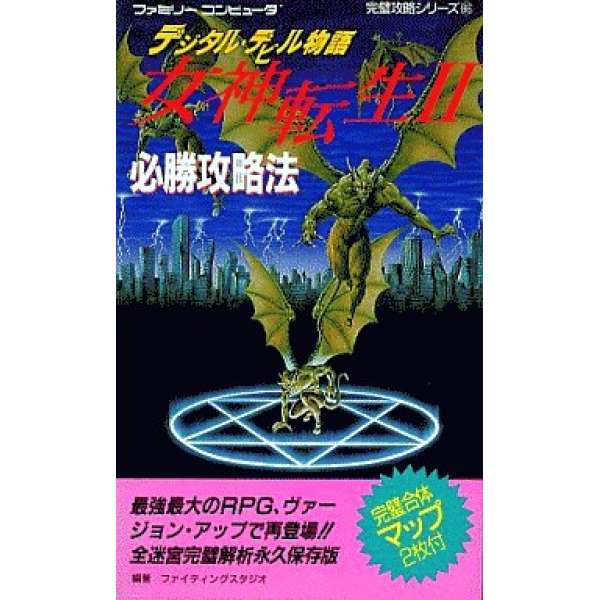
FC 數位惡魔故事 女神轉生2 必勝攻略法
 1990-04-30
由Atlus開發,並由Namco於1990年4月6日在任天堂Famicom(紅白機)上推出的《數位惡魔故事:女神轉生 2》(Digital Devil Story: Megami Tensei II),被公認RPG史上最具代表性的「暗黑系神作」之一。不僅完全擺脫初代改編自小說的框架,改以原創劇本重新構築世界觀,還確立了系列日後最具標誌性的核心要素,包括惡魔合體、末日廢墟氛圍,以及以 Law(秩序)、Neutral(中立)、Chaos(混沌)為基礎的多重結局系統。在紅白機生命週期的末期,以極高完成度挑戰當時由勇者鬥惡龍與太空戰士所主導的王道RPG結構,展現出截然不同的價值觀與敘事深度。
在技術表現上,堪稱8位元時代的巔峰之一。將原本單一的第一人稱迷宮探索進化為「2D鳥瞰大地圖」與「3D第一人稱迷宮」並行的複合結構。大地圖細膩地描繪出核戰後滿目瘡痍的東京景象,殘破的高樓與乾涸的地貌營造出濃厚的末世氣息;而在迷宮中,牆面貼圖與移動流暢度都達到當時同類型作品的高水準。音樂方面更是令人印象深刻,作曲家增子司透過紅白機音源極限,創作出帶有搖滾與工業風格的背景音樂,將壓抑與狂氣交織成極具辨識度的聲音風格。
故事背景設定在全球核戰爆發後數十年的東京,文明崩壞、惡魔橫行。主角原本只是生活在地下避難所的少年,卻在遊玩名為「Devil Busters」的電腦遊戲時,意外召喚出真正的惡魔帕祖祖,並因此獲得召喚惡魔的能力。隨著他與夥伴踏入廢墟世界,逐步揭開惡魔與人類之間的真相,劇情逐漸擴展至涉及神與魔的對立,甚至觸及路西法與至高存在之間的理念衝突。整體敘事不僅描寫末日求生,更深入探討信仰、秩序與混沌之間的灰色地帶,呈現出當時家用主機遊戲中極為罕見的哲學深度。
在操作系統上,奠定系列至今仍沿用的核心玩法。在戰鬥中不僅能進行攻擊,還可以透過對話與交涉讓敵對惡魔成為夥伴,每種惡魔都有獨特個性,必須根據情境選擇適當回應。進一步地,可在「邪教之館」進行惡魔合體,將多個仲魔融合成更強大的新個體,這種高度自由的培育系統帶來極強的策略性與沉浸感。同時,遊戲中的選擇會影響角色的屬性傾向,進而改變劇情走向與最終結局,讓整體體驗充滿變數與重玩價值。
在市場評價方面,被廣泛認為是紅白機RPG的頂點之一。評論界高度讚揚其大膽的世界觀、深度的系統設計與極具風格的音樂表現,認為它成功營造出一種壓抑卻令人著迷的遊戲氛圍。雖然其高難度、複雜迷宮與陰暗劇情使部分玩家卻步,但對於核心玩家而言,這正是其魅力所在。本作不僅奠定後續Shin Megami Tensei系列的基礎,也間接促成衍生作品Persona的誕生,被視為將電子遊戲推向探討人性與宗教議題的重要里程碑之作。
Released on April 6, 1990, for the Nintendo Famicom (NES), Digital Devil Story: Megami Tensei II (デジタルデビル物語 女神転生Ⅱ) was developed by Atlus and published by Namco. Widely regarded as one of the defining “dark masterpieces” in RPG history, the game broke free from the novel-based framework of its predecessor and introduced a fully original scenario written by Kazuyuki Suzuki. It established many of the series’ iconic elements, including demon fusion, a bleak post-apocalyptic atmosphere, and the multi-ending alignment system based on Law, Neutral, and Chaos. Arriving late in the Famicom’s lifespan, it stood as a bold counterpoint to the more traditional heroic narratives popularized by Dragon Quest and Final Fantasy.
In terms of technical achievement, Megami Tensei II represents one of the visual and audio peaks of the 8-bit era. The game evolved beyond the original’s purely first-person dungeon design by combining a top-down overworld map with first-person 3D labyrinth exploration. The overworld vividly depicts a devastated Tokyo after nuclear catastrophe, with ruined skyscrapers and dried seabeds conveying a haunting sense of desolation. Inside dungeons, the detailed textures and smooth movement pushed the Famicom hardware to its limits. The soundtrack, composed by Tsukasa Masuko, made striking use of the system’s sound capabilities, delivering rock- and industrial-inspired compositions that were widely praised at the time for their intensity and atmosphere.
The story is set in a post-nuclear Tokyo decades after global war has reduced civilization to ruins. The protagonist, a boy living in an underground shelter, accidentally summons a real demon named Pazuzu while playing a computer game called “Devil Busters.” Claiming the boy is destined to become a savior, Pazuzu grants him the ability to summon demons. As the protagonist ventures into the ruined world with his companions, he gradually uncovers a far more complex truth behind the demons and their agendas. The narrative expands across devastated districts such as Shibuya and Ginza, eventually reaching into the demon realm itself. At its core, the story explores ideological conflict between divine and demonic forces, including figures such as Lucifer and a supreme deity, raising philosophical questions about morality, faith, and human will rarely seen in console games of that era.
Gameplay introduces systems that would become foundational to the series. Combat is not limited to fighting; players can negotiate with enemies, using conversation, bribery, or intimidation to recruit demons as allies. Each demon has its own personality, requiring players to carefully choose dialogue options. The Cathedral of Shadows allows players to fuse multiple demons into stronger ones, creating a deep and addictive system centered on experimentation and optimization. The alignment system further enhances player agency, as choices throughout the story influence moral alignment, which in turn determines accessible demons, story paths, and endings. This absence of a clear-cut “good versus evil” structure was highly innovative at the time.
Upon release, Megami Tensei II received critical acclaim and is often considered one of the greatest RPGs on the Famicom. Reviewers praised its ambitious world-building, complex systems, and exceptional music, noting how it delivered a uniquely oppressive yet compelling experience. While its high difficulty, intricate dungeon design, and dark tone made it less accessible to casual players, it earned a devoted following among hardcore fans. The game laid the groundwork for future entries such as Shin Megami Tensei and its spin-off Persona, and is widely recognized as a milestone that elevated video games beyond simple entertainment into a medium capable of exploring deep philosophical and thematic ideas.
運費計算方式:
貨款滿1000元運費外加90元
貨款1000以下:買1件運費外加 60元,買2件運費外加 70元,
買3件運費外加 80元 ,買4件運費外加 90元
貨到付款外加30元手續費
外島及大陸地區運費另計
付款方式:
線上刷卡:本站採用Paypal線上刷卡
虛擬帳號匯款:屬於您專屬的虛擬帳戶,方便站長查帳使用,本站強力推薦
實體ATM匯款:請將匯款帳號記錄下來至各大銀行ATM提款機轉帳
超商條碼繳費:請列印本站提供的條碼至四大超商繳費
線上轉帳:透過玉山銀行線上ATM轉帳(此系統只支援IE瀏覽器)
貨到付款:本站採用黑貓宅急便貨到付款
其他注意事項:
如需購買線上點數卡請直接跟站長連絡,本站不提供點數卡的線上付款
-
FC 數位惡魔故事 女神轉生2 必勝攻略法
- 定 價: 681円
- 售 價: 0.00
- 庫存量: 0 套
- 已賣出: 0 套
人氣指數: 0 / 6 顆星