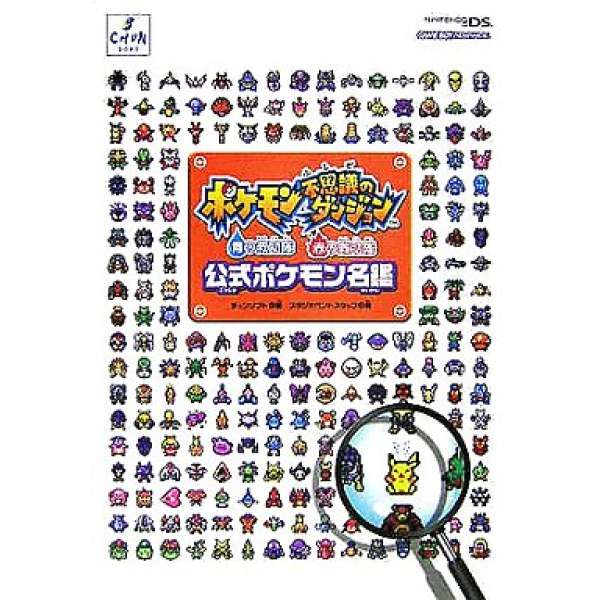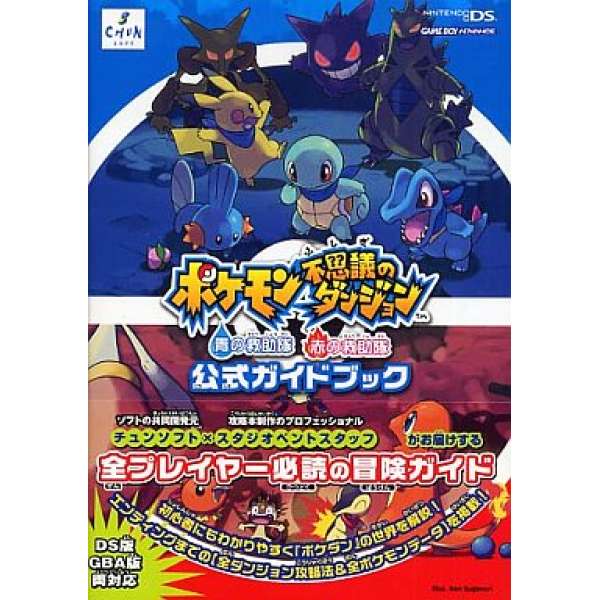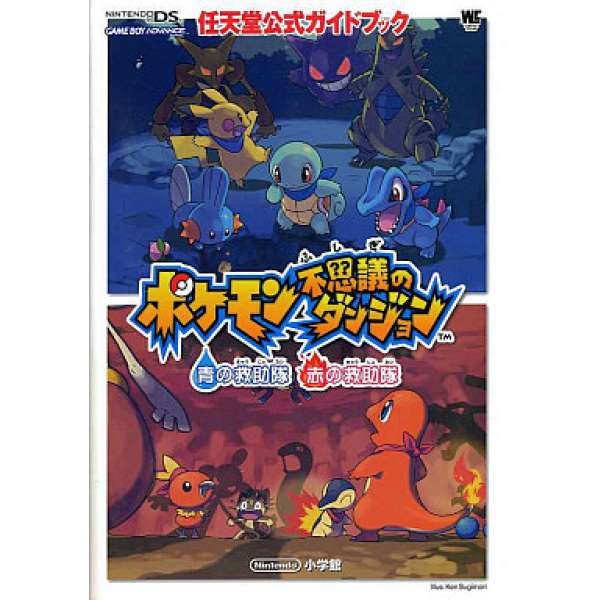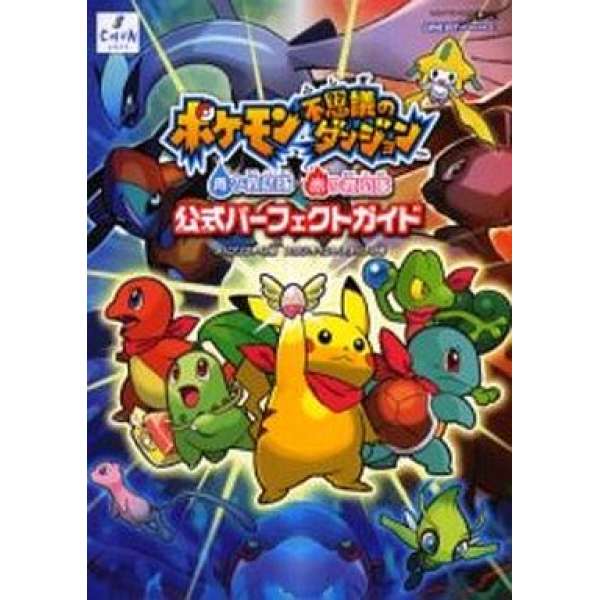
NDS/GBA 神奇寶貝 不可思議的迷宮 藍&紅色救難隊 官方神奇寶貝圖鑑
 2005-12-20
《GBA 寶可夢 不可思議的迷宮 赤之救助隊》(ポケモン不思議のダンジョン 赤の救助隊/Pokémon Mystery Dungeon: Red Rescue Team)是由 Nintendo 與 Spike Chunsoft 共同推出的經典角色扮演遊戲,日本於 2005 年 11 月 17 日正式登上 Game Boy Advance(GBA)平台。本作與同日推出於 Nintendo DS 的《藍之救助隊》共同構成《寶可夢 不可思議的迷宮》系列的開山作品,也是寶可夢遊戲史上極具代表性的衍生作品之一。它最大的突破,在於徹底改變傳統《寶可夢》系列「訓練師捕捉寶可夢、培育寶可夢並進行對戰」的基本模式,玩家這一次不再扮演人類訓練師,而是直接化身為一隻寶可夢,在充滿未知與危險的迷宮世界中展開冒險。
遊戲開場便以相當有特色的方式建立玩家與主角之間的關係。玩家原本是一名人類,但在故事開始時突然變成了一隻寶可夢,而且完全失去自己為何會變成寶可夢的記憶。遊戲會先透過一連串帶有幽默感的性格心理測驗,根據玩家的回答判定最適合的主角。最後可能成為皮卡丘、小火龍、妙蛙種子、伊布等不同寶可夢,總共提供 16 種主角選擇。這種設計讓玩家在遊戲開始之前,就產生一種「我的性格究竟會對應哪一隻寶可夢」的參與感,也成為《赤之救助隊》最令人印象深刻的開場之一。
成為寶可夢之後,主角會遇見一名當地寶可夢,兩人逐漸建立友誼並組成自己的「救助隊」。與傳統《寶可夢》遊戲為了取得道館徽章、挑戰四天王而旅行不同,《赤之救助隊》的核心任務是接受各種救援委託。世界各地的寶可夢會因為地震、山崩、暴風雨等自然災害而陷入危險,玩家必須進入神秘迷宮尋找失蹤的寶可夢,將它們帶回安全地區,或替其他寶可夢尋找重要物品、護送同伴前往指定地點。隨著救援任務逐漸增加,玩家的救助隊名聲也會不斷提升,故事因此從一支規模很小的地方救助隊逐漸發展成影響整個寶可夢世界的重要力量。
本作真正的核心玩法,就是「不可思議的迷宮」系統。每次進入迷宮時,地形、道路、房間、道具與敵人配置都可能重新生成,因此玩家無法單純依靠固定地圖記憶來通關。迷宮採用俯視角 2D 點陣畫面,而戰鬥與移動則以回合制進行。玩家每移動一步,敵人通常也會進行相應的行動,因此每一次前進、攻擊、使用道具甚至原地等待,都可能影響接下來的局勢。當玩家深入更高階的迷宮後,敵人的能力、地形與資源配置會變得更加危險,使遊戲逐漸從輕鬆的寶可夢冒險轉變成需要判斷與規劃的 Roguelike 式角色扮演體驗。
《赤之救助隊》的迷宮並不只是單純戰鬥場所。玩家可以在其中尋找各種道具、寶可夢招式、金錢與其他資源,也可以招募擊敗後願意加入的寶可夢。與一般《寶可夢》作品不同,玩家並不是透過精靈球捕捉寶可夢,而是透過救助隊系統逐漸擴大自己的隊伍。不同寶可夢具有不同屬性、招式與戰鬥能力,而玩家則可以透過升級、學習技能與進行隊伍配置,打造適合不同迷宮的冒險陣容。這種「招募+培養+組隊」的設計,使傳統寶可夢養成元素與 Mystery Dungeon 的隨機迷宮玩法產生非常自然的結合。
遊戲中的戰鬥也與傳統《寶可夢》作品有很大差異。玩家不是在獨立的戰鬥畫面中與敵人一對一對戰,而是在迷宮地圖中直接與敵方寶可夢交戰。由於所有行動都受到回合制影響,因此玩家需要考慮攻擊距離、技能範圍、敵人的位置以及隊友的行動。部分招式可以攻擊遠距離敵人,部分技能則能同時影響多個目標,因此熟悉寶可夢的招式特性在迷宮中非常重要。隨著故事進入後期,玩家還會遇到強大的 Boss 戰,這些戰鬥往往需要利用隊伍配置、技能與道具才能順利突破。
主線劇情則是《赤之救助隊》另一個非常重要的特色。遊戲一開始看似只是一名失去記憶的「人類變成寶可夢」的故事,但隨著救援任務逐漸增加,主角會接觸到更多關於世界異常現象的情報。各地接連發生的自然災害並非單純的偶然事件,許多寶可夢開始感受到世界正處於某種異常狀態。主角與夥伴在一次次救援行動中逐漸接近事件真相,同時也開始尋找「自己究竟為什麼會變成寶可夢」的答案。
因此,遊戲故事並不只是單純的冒險,而是同時包含友情、救援、身分認同與世界危機等元素。主角最初只想知道自己為何會失去人類身分,但在與夥伴共同生活、接受救援委託以及面對各種危機的過程中,逐漸真正融入寶可夢世界。原本只是一個「想找回過去」的人類,最後卻必須面對一個更大的問題:即使知道自己的真正身分,自己究竟又會選擇成為什麼樣的存在?
《赤之救助隊》在主線劇情中安排了大量 Boss 戰與大型迷宮,玩家的角色等級會在主要冒險之間保留下來,因此角色培養具有相當明確的成長感。隨著故事推進,玩家會逐步解鎖新的地區與迷宮,也會接觸到更多寶可夢以及更高難度的挑戰。與傳統《寶可夢》遊戲不同,本作並沒有將重點放在「收集八個徽章」或「成為寶可夢聯盟冠軍」,而是將玩家一路帶向世界危機的核心,最終必須與強大的傳說級寶可夢以及其他重要角色交戰。
而《赤之救助隊》真正龐大的內容,其實是在主線結束、製作人員名單播放之後才逐漸展開。通關並不代表遊戲真正結束,玩家可以繼續探索新的迷宮、挑戰更高難度的內容,並解鎖進化系統、特殊迷宮、陷阱、新道具、Friend Areas 以及更多 Boss。部分迷宮甚至會重置玩家等級,使原本已經培養到很高等級的寶可夢重新從低等級開始挑戰,進一步提高遊戲的 Roguelike 挑戰性。
在寶可夢收集方面,《赤之救助隊》也具有相當龐大的內容。遊戲可以招募與進化大量寶可夢,整體可取得的寶可夢數量達到 386 種,其中還包括 Unown 的 28 種不同型態。這使遊戲後期逐漸從單純的故事冒險轉變成長期收集與培養作品。玩家可以建立不同類型的救助隊,嘗試不同屬性與技能組合,再進入高難度迷宮挑戰自己的隊伍配置。
值得注意的是,《赤之救助隊》與 Nintendo DS 的《藍之救助隊》並不是完全相同的版本。兩款作品擁有共同的核心故事與玩法,但由於分別對應 GBA 與 Nintendo DS,因此在部分內容、可取得寶可夢與遊戲功能上存在差異。這種雙平台同步推出的策略,也讓 2005 年的《寶可夢 不可思議的迷宮》成為當時 Nintendo 跨平台作品中相當特別的一次嘗試。後來兩款作品都曾推出 Wii U Virtual Console 版本,而《赤之救助隊》也在後續 Nintendo Classics 的服務中獲得重新遊玩的機會。
從系列歷史來看,《寶可夢 不可思議的迷宮 赤之救助隊》的重要性非常高。它首次將寶可夢世界與 Mystery Dungeon 的隨機迷宮 RPG 系統結合,不但建立了全新的遊戲模式,也證明《寶可夢》角色即使脫離傳統訓練師與精靈球系統,依然能夠形成完整而具有吸引力的角色扮演遊戲。玩家不再只是站在訓練師身後指揮寶可夢,而是真正以寶可夢本身的身分生活、戰鬥、交朋友與拯救其他同伴。
整體而言,《GBA 寶可夢 不可思議的迷宮 赤之救助隊》是一款兼具劇情、養成、探索與隨機迷宮挑戰的特殊 RPG。它最成功的地方,是將寶可夢原本的收集與養成精神,與 Mystery Dungeon 的回合制隨機迷宮系統融合在一起,再透過「人類變成寶可夢」的故事設定建立玩家與主角之間的情感連結。對 GBA 復古玩家而言,它不只是寶可夢系列的一款外傳,而是整個《寶可夢 不可思議的迷宮》系列真正的起點,也是任天堂掌機時代相當具代表性的 RPG 作品之一。
Pokémon Mystery Dungeon: Red Rescue Team (ポケモン不思議のダンジョン 赤の救助隊) is a classic role-playing game developed through a collaboration between Nintendo and Spike Chunsoft, released in Japan for the Game Boy Advance on November 17, 2005. Released alongside the Nintendo DS title Pokémon Mystery Dungeon: Blue Rescue Team, it became the foundation of the Pokémon Mystery Dungeon series and introduced one of the most significant departures from the traditional Pokémon formula. Instead of playing as a human Pokémon Trainer who captures and raises Pokémon, the player actually becomes a Pokémon and experiences the world from the Pokémon's perspective.
The game begins with an unusual premise. The protagonist was originally a human, but for unexplained reasons suddenly finds themselves transformed into a Pokémon. Even more strangely, the protagonist has lost all memories of their former human life. Before the adventure begins, the game presents the player with a humorous personality questionnaire. Depending on the player's answers, the game determines which Pokémon best matches their personality. The protagonist can become one of 16 possible Pokémon, including Pikachu, Charmander, Bulbasaur, Eevee, and several other candidates. This opening immediately establishes one of the game's defining characteristics: the protagonist is not simply a character chosen from a menu, but a Pokémon whose identity is connected directly to the player's own responses.
After awakening in the Pokémon world, the protagonist encounters another Pokémon and gradually develops a friendship with them. The two eventually form their own Rescue Team, accepting requests from Pokémon who have become trapped or endangered. Unlike the traditional Pokémon series, where the player's main objective is usually to collect Gym Badges and eventually challenge the Pokémon League, Red Rescue Team revolves around rescue missions. Pokémon may become lost in dangerous Mystery Dungeons, require an important item, need an escort, or become trapped because of natural disasters. The player's Rescue Team ventures into these dangerous areas to complete the requested missions and bring those Pokémon safely home.
The central gameplay system is the Mystery Dungeon itself. Each time the player enters a dungeon, its layout can change, with rooms, corridors, items, enemies, and other elements being procedurally generated. Because of this, players cannot simply memorize a fixed map and follow the same route every time. Dungeon exploration takes place from a top-down 2D perspective, while movement and combat are fundamentally turn-based. Whenever the player moves, attacks, uses an item, or performs another action, enemies can respond accordingly. This creates a very different rhythm from traditional Pokémon battles and requires the player to consider positioning, distance, available resources, and the behavior of surrounding enemies.
The dungeons are also much more than simple combat arenas. Players can discover useful items, money, technical resources, and other equipment while exploring. Hostile Pokémon can be defeated and, under the appropriate conditions, recruited into the Rescue Team. Instead of catching Pokémon with Poké Balls as in the main series, the player gradually expands their team through the Rescue Team system. Different Pokémon possess different types, statistics, abilities, and moves, allowing players to construct teams suited to different dungeon environments. Leveling up and learning new moves further expands the game's character-development system.
Combat itself is another major departure from traditional Pokémon gameplay. Battles do not switch to a separate combat screen. Instead, the player fights directly within the dungeon environment. Since the game operates on a turn-based system, every movement and attack can influence the next turn. Players must consider the distance between themselves and an enemy, the position of teammates, the range of their moves, and the possibility of attacking several opponents at once. Long-range moves can be particularly valuable against dangerous enemies, while area-of-effect attacks can become essential when the player is surrounded.
The main story gives the game a much stronger narrative identity than a typical mission-based dungeon crawler. At first, the protagonist is primarily concerned with discovering why a human has been transformed into a Pokémon. However, as the Rescue Team begins accepting more missions, the characters encounter evidence that something unusual is happening throughout the Pokémon world. Natural disasters are occurring with increasing frequency, and Pokémon everywhere are becoming involved in mysterious incidents. What initially appears to be a personal mystery gradually develops into a much larger crisis affecting the entire world.
The protagonist and their partner therefore become involved in events far beyond ordinary rescue missions. Each adventure reveals more information about the strange situation surrounding the world, while simultaneously bringing the protagonist closer to the truth about their transformation. The story combines friendship, courage, rescue missions, personal identity, and a growing global crisis. One of its central themes is whether a being's original identity or purpose must determine who they ultimately become.
This theme is particularly important because the protagonist gradually becomes part of the Pokémon community. At the beginning of the game, their primary goal is to recover their memories and discover what happened to their human self. However, through repeated rescue missions and interactions with other Pokémon, the protagonist develops genuine relationships and begins to care about the Pokémon world as their own home. The question eventually becomes more complicated than simply discovering their past: even if they learn who they once were, what kind of person—or Pokémon—do they want to become now?
The main storyline contains numerous major dungeons and boss encounters. Unlike certain traditional roguelike games, the player's character progression is maintained throughout the main story, allowing the protagonist and their teammates to become stronger as the adventure progresses. New areas and challenges are gradually introduced, and the player encounters increasingly powerful Pokémon. The later stages of the story expand the scale of the adventure dramatically, eventually leading the Rescue Team toward a confrontation involving some of the most powerful Pokémon in the world.
One of the game's greatest strengths is that the adventure does not truly end when the main story is completed. After the credits, a substantial amount of additional content becomes available. Players can access new dungeons, stronger opponents, new items, additional Friend Areas, new bosses, and further developments in the story. Evolution mechanics also become more important, while some special dungeons introduce level-reset rules that force the player's Pokémon to temporarily return to a much lower level. These areas create a much greater challenge and emphasize resource management, strategic movement, and knowledge of the Mystery Dungeon system.
The post-game content also significantly expands the game's collection aspect. Across the game's broader content, players can recruit or evolve 386 Pokémon, including 28 different forms of Unown. This gives the game a substantial long-term objective beyond simply completing the main story. Players can experiment with different team combinations, develop Pokémon with different move sets, and build specialized Rescue Teams for particular dungeons. As a result, the game can continue providing challenges long after the primary narrative has been completed.
Red Rescue Team was released alongside Pokémon Mystery Dungeon: Blue Rescue Team for the Nintendo DS. Although both games share the same fundamental concept and storyline, the two versions contain platform-specific differences and variations in available content. Their simultaneous release also represented an interesting strategy for Nintendo, allowing the Mystery Dungeon concept to reach both the GBA and the newer Nintendo DS hardware generation.
From a historical perspective, Pokémon Mystery Dungeon: Red Rescue Team is one of the most important Pokémon spin-offs of the handheld era. It demonstrated that the Pokémon universe could support a completely different gameplay structure without relying on the traditional Trainer-versus-Trainer formula. By combining Pokémon collection and character development with Mystery Dungeon's randomly generated environments and turn-based exploration, the game created a new way of experiencing the Pokémon world.
The game's greatest achievement is the way its gameplay and narrative reinforce one another. The player is not simply told that the protagonist is a Pokémon—the player actually experiences the world as one. Instead of standing behind a Trainer and issuing commands, the player personally explores dungeons, fights enemies, rescues other Pokémon, forms friendships, develops skills, and gradually becomes part of the Pokémon community. The transformation from human to Pokémon therefore becomes more than a plot device; it becomes the foundation of the entire gameplay experience.
Overall, Pokémon Mystery Dungeon: Red Rescue Team is a distinctive RPG that combines story-driven adventure, Pokémon development, exploration, recruitment, and procedurally generated Mystery Dungeons. Its mixture of traditional Pokémon concepts with the mechanics of the Mystery Dungeon genre created a formula that would continue throughout numerous later entries in the franchise. For GBA collectors and retro RPG enthusiasts, Red Rescue Team is not merely a Pokémon spin-off, but the starting point of one of Pokémon's most enduring secondary series and one of the notable role-playing experiences of the Game Boy Advance era.
運費計算方式:
貨款滿1000元運費外加90元
貨款1000以下:買1件運費外加 60元,買2件運費外加 70元,
買3件運費外加 80元 ,買4件運費外加 90元
貨到付款外加30元手續費
外島及大陸地區運費另計
付款方式:
線上刷卡:本站採用Paypal線上刷卡
虛擬帳號匯款:屬於您專屬的虛擬帳戶,方便站長查帳使用,本站強力推薦
實體ATM匯款:請將匯款帳號記錄下來至各大銀行ATM提款機轉帳
超商條碼繳費:請列印本站提供的條碼至四大超商繳費
線上轉帳:透過玉山銀行線上ATM轉帳(此系統只支援IE瀏覽器)
貨到付款:本站採用黑貓宅急便貨到付款
其他注意事項:
如需購買線上點數卡請直接跟站長連絡,本站不提供點數卡的線上付款
-
NDS/GBA 神奇寶貝 不可思議的迷宮 藍&紅色救難隊 官方神奇寶貝圖鑑
- 定 價: 1,365円
- 售 價: 0.00
- 庫存量: 0 套
- 已賣出: 0 套
人氣指數: 1.5 / 6 顆星