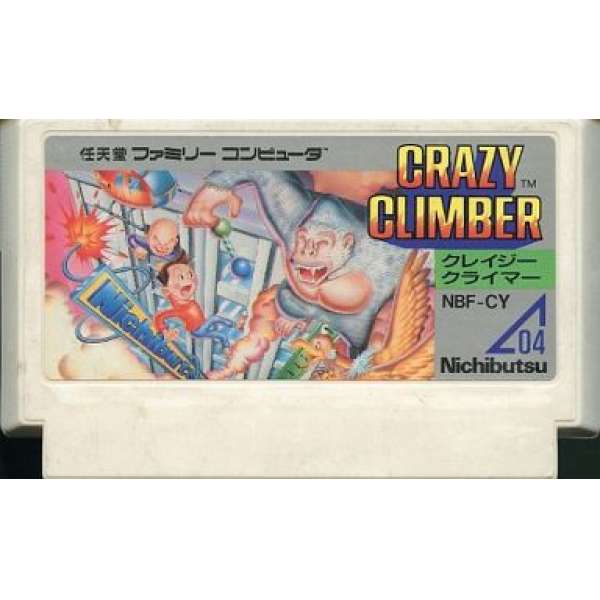
瘋狂攀爬者 / 瘋狂爬梯工 (無書盒)
由Nichibutsu於1986年12月26日在任天堂 Famicom(紅白機)推出的《瘋狂攀爬者》(Crazy Climber/クレイジークライマー),被公認為遊戲史上最具代表性的「垂直攀爬」動作遊戲鼻祖之一。改編自1980年極為熱門的同名大型電玩,並以其獨樹一幟的操作方式與充滿惡搞風格的關卡設計,在80年代中期的遊戲市場中佔據一個極為特殊的位置。它不強調戰鬥,而是透過對高度壓力與操作精準度的要求,帶來截然不同的遊戲體驗。
在技術表現方面,成功將大型電玩那種「不斷向上延伸」的視覺張力移植到紅白機上。雖然畫面以今日標準來看較為簡約,但開發團隊仍巧妙地在有限的解析度中營造出高樓聳立的壓迫感。遊戲由多棟風格各異的摩天大樓構成,隨著玩家逐步向上攀爬,背景的色調也會產生變化,呈現出時間與高度的轉換感。音效設計同樣令人印象深刻,無論是攀爬時的節奏聲響、失足墜落的音效,還是關卡開始時那段極具辨識度的電子旋律,都成為玩家難以忘懷的經典元素。甚至為了還原街機版本的雙搖桿操作,當年還推出專用的控制器配件,可見其對操作體驗的重視。
劇情設定極為簡單,卻充滿80年代特有的荒誕幽默。玩家扮演一名身分不明的攀爬者,穿著普通工作服,目標只是單純地挑戰自我極限,徒手攀上數棟充滿危險的高樓。整個城市彷彿與他為敵,從窗戶裡的住戶到各種突發事件,都不斷阻撓他的前進。當玩家最終成功登頂,並抓住前來接應的直升機時,那種征服高度的成就感,便是這場冒險唯一卻最純粹的回報。
在操作設計上,拋棄傳統動作遊戲的跳躍與攻擊系統,轉而採用極具實驗性的「左右手分離操作」。必須交替控制角色的左手與右手抓住窗框,形成一種節奏感強烈的攀爬動作。一旦操作失誤,例如雙手同時放開或未能抓穩,角色就會直接墜落。這種設計大幅提升遊戲的緊張感與挑戰性。
關卡中的障礙設計更是本作的一大特色。窗戶可能突然關閉夾住角色的手,住戶會從窗內丟出花盆或潑水干擾,甚至還會出現巨大的猩猩(明顯致敬《金剛》)阻擋去路。此外,帶電的招牌與不穩定的窗框也讓攀爬過程充滿變數。玩家必須隨時觀察環境變化,在左右窗戶之間快速切換,以躲避從上方落下的危險物。
在高難度關卡中,部分窗框會因為結構不穩而無法長時間抓取,迫使玩家在維持節奏的同時迅速做出判斷。隨著遊戲進行,障礙出現的頻率與複雜度也逐步提升,使整體體驗更加緊湊且充滿壓迫感。這種在極限狀態下求生存的操作快感,正是本作最核心的魅力所在。
在市場評價方面,呈現出兩極化但極具影響力的反響。評論普遍肯定其創新性,認為它突破動作遊戲必須依賴戰鬥的既有框架,單純透過「移動與閃避」就能創造高度緊張的遊戲體驗。然而,其獨特的操作方式與偏高的難度,也讓部分玩家感到挫折甚至難以適應。對於熱衷挑戰操作極限的玩家而言,本作卻是一款耐玩度極高的經典之作。
整體而言,《瘋狂攀爬者》不僅是日本物產在紅白機時期最具代表性的作品之一,更是一款在遊戲設計史上具有開創意義的經典。其「在極限邊緣求生」的玩法理念,至今仍持續影響著許多強調高難度與精準操作的獨立遊戲,成為後世反覆借鑑的重要靈感來源。
Crazy Climber (クレイジークライマー), released on December 26, 1986 for the Nintendo Famicom (NES) by Nichibutsu, is widely regarded as one of the earliest and most influential “vertical climbing” action games in video game history. Adapted from the highly popular 1980 arcade original, the game stood out in the mid-1980s for its unconventional dual-control climbing mechanics and its humorously chaotic obstacle design. Rather than focusing on combat, it challenges players’ fear of heights, reflexes, and fine motor coordination under pressure.
In terms of presentation, Crazy Climber faithfully recreates the arcade game’s sense of vertical scale. Although the Famicom’s graphics are relatively simple, the developers effectively convey the towering height of skyscrapers within the limited screen space. The game features multiple buildings with distinct visual styles, and as players ascend, subtle background color changes simulate the passage of time and altitude. One of its most memorable elements is its catchy electronic sound design—the distinctive sounds of climbing and falling, along with the energetic stage-start jingle, became iconic. To better replicate the arcade experience, a special dual D-pad controller accessory was even released, demonstrating the developers’ commitment to preserving its unique control scheme.
The story is minimalistic and infused with a sense of absurd humor typical of the 1980s. Players take on the role of an unnamed “crazy climber,” dressed in a simple jumpsuit, whose sole goal is to scale a series of heavily guarded skyscrapers using only his bare hands. There is no grand narrative of saving the world—just a personal challenge of endurance and determination. The buildings themselves seem almost alive, actively resisting the player’s ascent through hostile inhabitants and unpredictable hazards. Upon finally reaching the top and grabbing onto a waiting helicopter, the sense of accomplishment—overlooking the city from great height—serves as the ultimate reward for this bizarre yet thrilling journey.
Gameplay revolves around a highly experimental control system that simulates real climbing rather than traditional jumping mechanics. Players must alternate control of the character’s left and right hands to grip windows and ascend. This creates a rhythm-based input pattern, where losing coordination or releasing both hands simultaneously results in a fall. The buildings are filled with a wide variety of hazards: windows may suddenly shut and trap the player’s hands, residents throw objects such as flowerpots or buckets of water, and even giant apes—clearly inspired by King Kong—appear to interfere. Electrified signs and collapsing footholds further increase the challenge. Players must constantly observe incoming dangers while switching laterally between windows to avoid obstacles.
Timing is crucial, especially when dealing with unstable windows that cannot be held for long. In later stages, hazards appear more frequently, forcing players to maintain a steady climbing rhythm while precisely predicting their next move. This balance between speed, precision, and survival under pressure forms the core of the game’s appeal.
Critically, Crazy Climber received a polarized but ultimately influential reception. It was praised for its originality and for redefining what an action game could be, relying purely on movement and evasion rather than combat to create tension. However, its unconventional controls and high difficulty made it frustrating for players accustomed to traditional gameplay styles. For those who embraced its challenge, though, it became an endlessly replayable experience. The game is widely recognized as one of Nichibutsu’s most successful titles, and its distinctive “edge-of-survival” gameplay continues to inspire modern indie developers designing high-difficulty, skill-based experiences.
運費計算方式:
貨款滿1000元運費外加90元
貨款1000以下:買1件運費外加 60元,買2件運費外加 70元,
買3件運費外加 80元 ,買4件運費外加 90元
貨到付款外加30元手續費
外島及大陸地區運費另計
付款方式:
線上刷卡:本站採用Paypal線上刷卡
虛擬帳號匯款:屬於您專屬的虛擬帳戶,方便站長查帳使用,本站強力推薦
實體ATM匯款:請將匯款帳號記錄下來至各大銀行ATM提款機轉帳
超商條碼繳費:請列印本站提供的條碼至四大超商繳費
線上轉帳:透過玉山銀行線上ATM轉帳(此系統只支援IE瀏覽器)
貨到付款:本站採用黑貓宅急便貨到付款
其他注意事項:
如需購買線上點數卡請直接跟站長連絡,本站不提供點數卡的線上付款
-
瘋狂攀爬者 / 瘋狂爬梯工 (無書盒)
- 定 價: 5,724円
- 售 價: 0.00
- 庫存量: 0 套
- 已賣出: 0 套
 人氣指數: 0.6 / 6 顆星