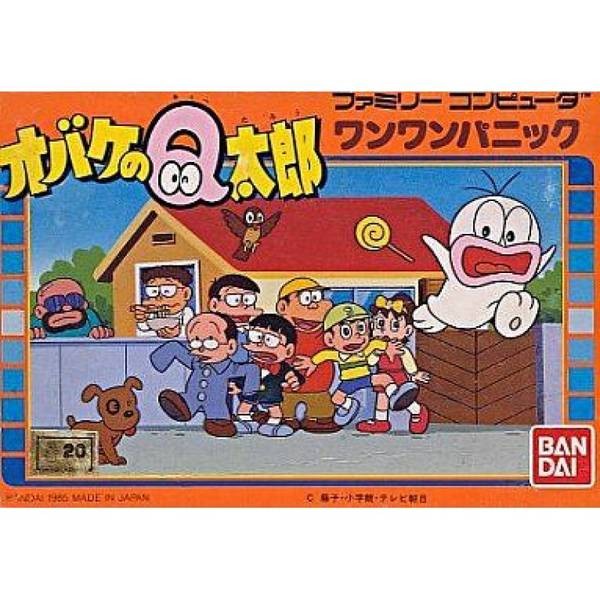
Q太郎
 1985-12-16
由 Bandai 於 1985 年 12 月 16 日在任天堂 Famicom(紅白機)上推出的《Q 太郎:犬犬恐慌》(Obake no Q-Tarou: Wanwan Panic),改編自 藤子不二雄 的經典漫畫《小鬼 Q 太郎》。在台灣玩家之間,這款作品通常直接被稱為「小鬼 Q 太郎」,並以極高難度與獨特機制聞名,成為許多早期紅白機玩家心中難以忘懷的「童年惡夢」。
與當時多數動作遊戲不同,最大的特色在於角色的移動方式。不同於 超級瑪利歐兄弟 那種以跳躍為核心的操作,Q 太郎幾乎全程在空中「飄浮」移動。可以自由控制上下飛行,但這種能力並非無限使用,而是會持續消耗體力。畫面風格雖然走可愛路線,背景多為日本街道、郊外與森林等日常場景,但實際遊玩時卻充滿壓力與挑戰。
忠實呈現原作設定中 Q 太郎「怕狗」的弱點,而且轉化成極為嚴苛的機制。只要碰到狗,或被畫面中以文字呈現的「汪!」聲波擊中,角色就會立即死亡,沒有任何緩衝空間。在飛行時必須極度精準地控制高度與距離,即使是看似簡單的關卡,也隨時可能因為一隻突然出現的狗而失敗。
劇情圍繞著 Q 太郎拯救被擄走的朋友展開,包括正太(正ちゃん)等人被分散到各個地點。需要穿越共 12 個關卡,一邊閃避各種敵人與環境陷阱,一邊尋找關卡終點被困的同伴。過程中還設有隱藏路線,可能通往提供獎勵的「天國」,也可能誤入充滿危險的「地獄」,讓整體流程更具變化與不確定性。
在操作層面上,核心在於體力管理與精準操控。畫面上方的體力條以糖果圖示呈現,飛行時會持續消耗,必須不斷收集飯糰、拉麵等食物來補充能量。一旦體力耗盡,Q 太郎就會直接從空中墜落而死。除了基本的閃避動作外,透過取得特定道具,角色還能發射類似噴火的遠距攻擊來擊退敵人,但整體而言仍偏向以生存與躲避為主,而非積極戰鬥。
這款遊戲在當時獲得相當兩極的評價。一方面,其創新的飛行系統與角色特性轉化受到肯定;另一方面,過於嚴苛的判定與快速流失的體力設計,也讓不少玩家感到挫折。特別是對當年的年幼玩家而言,遊戲難度顯得過高。不過在海外版本中,被改名為《Chubby Cherub》,主角變成類似邱比特的小天使,但「怕狗即死」的機制卻依然保留,反而產生一種頗為違和的趣味感。
從歷史角度來看,本作是早期動漫改編遊戲的重要代表之一。它成功地將角色個性——愛吃、會飛、怕狗——轉化為實際的遊戲系統,儘管在平衡性上有所爭議,但仍展現出當時開發者在設計上的創意與嘗試。
對許多玩家來說,最深刻的回憶莫過於那種手忙腳亂的緊張感:一邊拼命找食物維持體力,一邊在空中小心翼翼地閃避敵人,卻常常被突然跳起來的狗嚇到失控,最後直直摔出畫面。那種既可愛又殘酷的體驗,正是紅白機時代特有的魅力所在。
Released by Bandai on December 16, 1985, for the Nintendo Famicom, Obake no Q-Tarou: Wanwan Panic is a side-scrolling action game based on the classic manga Obake no Q-Tarou created by Fujiko Fujio. Among Taiwanese players, the game is more commonly remembered as “Little Ghost Q-Taro,” and it gained a reputation for its punishing difficulty and unusual identity-driven gameplay mechanics, making it something of a “nightmare” for early Famicom players.
What made this game stand out among action titles of its time was the way the protagonist moved. Rather than jumping like characters in games such as Super Mario Bros., Q-Taro spends most of his time floating through the air. His design is round and charming, and the stages depict everyday Japanese settings like neighborhoods, countryside paths, and forests. Despite its friendly appearance, the game hides a surprisingly unforgiving challenge. The flight system allows players to freely move up and down in midair, but doing so constantly drains stamina. Staying airborne requires careful resource management, which becomes the core tension of the experience.
True to the original manga, Q-Taro has a fatal weakness: dogs. This trait is faithfully translated into gameplay in a brutally literal way. Any contact with a dog, or even being hit by the “bark” sound effect displayed as on-screen text, results in instant death. This mechanic alone turns otherwise simple encounters into moments of extreme stress, forcing players to precisely control their altitude and movement at all times.
The story revolves around Q-Taro trying to rescue his captured friends, including Sho-chan, who have been scattered across various locations. The game consists of twelve stages, each filled with animals, enemies, and environmental hazards. As Q-Taro progresses, he must avoid relentless dogs while navigating increasingly complex layouts. At the end of each stage, the goal is to find and rescue a trapped friend. Along the way, players may encounter hidden routes leading to “Heaven” for bonuses or “Hell” for punishment stages, adding an extra layer of unpredictability.
The gameplay system emphasizes stamina management and careful control. A candy-based stamina meter sits at the top of the screen, gradually depleting as Q-Taro flies. Players must constantly collect food items such as rice balls and ramen to replenish energy. If the meter runs out, Q-Taro simply falls from the sky and dies. Offensive options are limited, but by collecting certain items, he can gain a projectile attack—often depicted as a kind of fire breath—to deal with enemies. Even so, survival depends far more on evasion than combat, especially when dealing with the unpredictable movements and attacks of dogs. Hidden passages scattered throughout the stages further reward exploration, though they can just as easily lead to danger as to relief.
Upon release, the game received mixed reactions. Critics acknowledged its originality but often pointed out its harsh difficulty and unforgiving collision detection. For younger players in particular, the fast-draining stamina and instant-death hazards made it frustratingly difficult. Interestingly, the game was localized overseas under the title Chubby Cherub, where Q-Taro was replaced by a winged cherub-like character, though the peculiar “fear of dogs” mechanic remained, creating a somewhat odd disconnect in theme.
In terms of historical significance, the game stands as an early example of anime-to-game adaptation that successfully translated character traits into gameplay systems. While its controls and balance were controversial, it captured the essence of Q-Taro—his love of food, his ability to fly, and his crippling fear of dogs—in a way that felt mechanically unique.
For many players, the most unforgettable memory is that constant sense of panic—frantically searching for food to stay airborne while suddenly being startled by a leaping dog, only to lose control and fall off the screen. It’s the kind of experience that perfectly captures the strange charm and cruelty of early Famicom-era design.
運費計算方式:
貨款滿1000元運費外加90元
貨款1000以下:買1件運費外加 60元,買2件運費外加 70元,
買3件運費外加 80元 ,買4件運費外加 90元
貨到付款外加30元手續費
外島及大陸地區運費另計
付款方式:
線上刷卡:本站採用Paypal線上刷卡
虛擬帳號匯款:屬於您專屬的虛擬帳戶,方便站長查帳使用,本站強力推薦
實體ATM匯款:請將匯款帳號記錄下來至各大銀行ATM提款機轉帳
超商條碼繳費:請列印本站提供的條碼至四大超商繳費
線上轉帳:透過玉山銀行線上ATM轉帳(此系統只支援IE瀏覽器)
貨到付款:本站採用黑貓宅急便貨到付款
其他注意事項:
如需購買線上點數卡請直接跟站長連絡,本站不提供點數卡的線上付款